Workers gather in a semi-circle, hard hats on, coffee in hand. A supervisor holds a laminated sheet outlining today’s topic: ladder safety. This isn’t a formal training session. It’s quick—10 minutes max. But it’s focused, relevant, and timely. This is a toolbox talk in action.
And if you're asking, What is a toolbox talk meaning?, the answer isn’t just a definition. It’s about intent, timing, and culture.
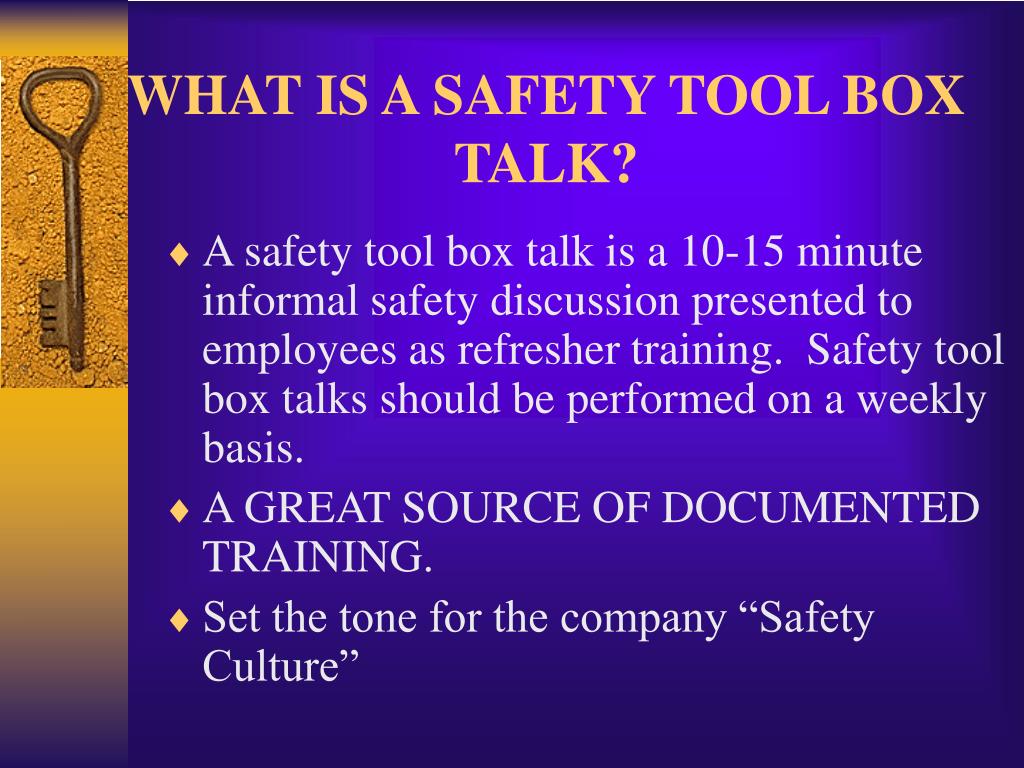
A toolbox talk is a short, informal safety meeting held at the job site, typically before work begins. It focuses on a specific hazard, procedure, or safety concern relevant to the day’s tasks. But beyond that basic explanation, its true meaning lies in its function: to reinforce awareness, reduce risk, and create a shared responsibility for safety across teams.
This article unpacks what a toolbox talk truly means—from its purpose and structure to how it fits into real-world operations. You’ll learn not just what it is, but why it works, when it fails, and how to make yours actually stick.
The Core Meaning of a Toolbox Talk
At its heart, a toolbox talk means proactive risk communication.
It’s not a lecture. It’s not a compliance checkbox. It’s a focused conversation—brief by design—meant to align a team on safety priorities for that day or task.
The term "toolbox" reflects both location and practicality. These talks happen where the work happens: near equipment, beside scaffolding, or in the shadow of a half-built structure. The idea is to keep safety grounded in reality, not buried in paperwork.
Key elements of its meaning include: - Timeliness: Addressing risks before they become incidents - Specificity: Focusing on one topic, not a broad safety overview - Participation: Encouraging input from workers, not just top-down instruction - Relevance: Tied directly to current tasks, weather, site conditions, or recent near-misses
For example, if a crew is installing roofing materials on a windy day, the toolbox talk might focus on securing tools, wearing harnesses, and spotting falling object zones. That immediacy is what gives the practice meaning.
How Toolbox Talks Differ from Other Safety Meetings
Many confuse toolbox talks with safety inductions, pre-shift briefings, or formal training. But the distinction matters.
| Meeting Type | Duration | Scope | Frequency |
|---|---|---|---|
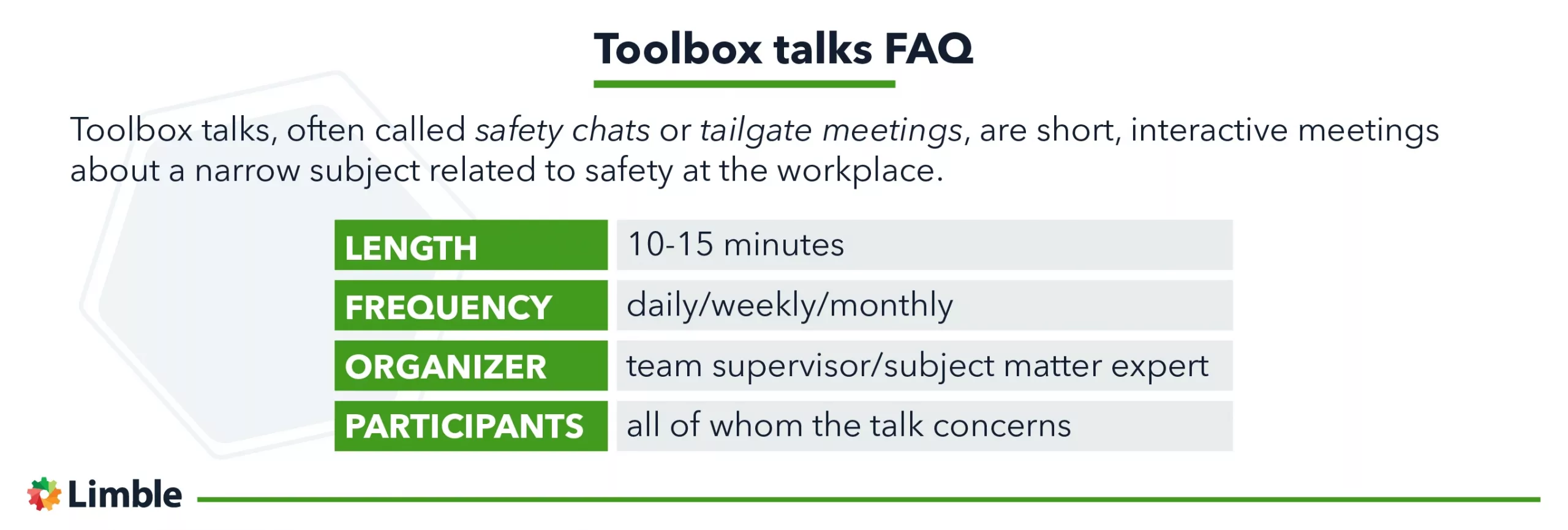
| Toolbox Talk | 5–15 minutes | One specific hazard or task | Daily or weekly |
| Safety Induction | 30+ minutes | General site rules | Once per worker |
| Pre-Shift Briefing | 10–20 minutes | Task assignments, logistics | Daily |
| Formal Safety Training | Hours to days | In-depth procedures, certifications | Quarterly or annually |
A toolbox talk’s power lies in its narrow scope and repetition. While formal training teaches how to use a forklift, a toolbox talk might highlight today’s forklift blind spots due to fog or cluttered pathways.
Too often, companies treat toolbox talks like compliance rituals—read aloud from a template, signed off, forgotten. That’s when they lose meaning. The real value comes from adaptation and engagement, not box-ticking.
When and Where Toolbox Talks Are Most Effective
Toolbox talks work best when triggered by specific conditions—not just scheduled because “it’s Tuesday.”
Ideal triggers include: - Starting a high-risk task (working at height, excavation, hot work) - Introducing new equipment or subcontractors - After a near-miss or incident - Weather changes (high wind, heat, rain) - Shift changes or new crew members
For instance, a plumbing crew preparing to enter a confined space should have a toolbox talk on atmospheric testing, rescue plans, and communication signals—right before entry, not a week prior.
Location also impacts effectiveness. Conducting the talk at the point of work—not in an office or trailer—increases relevance. Workers see the actual hazard, which reinforces the message.
A common mistake? Holding talks in the break room while the work zone is a quarter-mile away. Out of sight, out of mind.
Structure of an Effective Toolbox Talk
A meaningful toolbox talk follows a simple but intentional structure. Skip any part, and the impact drops.
#### 1. Set the Context (1 min) Explain why this topic matters today. Example: “We’re starting trench work this morning—so today’s talk is on cave-in risks.”
#### 2. Describe the Hazard (3 min) Be specific. Not “trenches are dangerous,” but “soil type here is sandy, which increases collapse risk within 3 feet.”
#### 3. Review Controls (4 min) Cover what’s being done to mitigate risk: shoring, sloping, spotters, emergency procedures.
#### 4. Encourage Questions & Input (3 min) Ask: “Has anyone seen similar conditions before? What worked?” Workers on the ground often spot risks supervisors miss.
#### 5. Confirm Understanding (1 min) Quick check: “So, if the trench walls start cracking, what’s the first action?”
End with signatures or a log entry, but only if the conversation happened first.
Common Mistakes That Drain Meaning from Toolbox Talks
Even with good intentions, many toolbox talks fail to land. Here’s why:
1. Over-reliance on templates Using the same “fall protection” talk every week—even when no one’s working at height—signals that safety is a formality, not a priority.
2. Monologue instead of dialogue If the supervisor does all the talking, engagement drops. Safety isn’t absorbed—it’s ignored.
3. Wrong timing Holding a talk about crane safety two days before lifting begins means workers won’t retain it.
4. No follow-up If hazards are raised but never acted on (“We’re worried about that frayed cable”), trust erodes fast.
5. Skipping documentation While the talk matters more than the paper, failing to log attendance or topics leaves teams vulnerable during audits or investigations.
The best approach? Use templates as a starting point, then customize on the spot based on real conditions.
Real-World Use Cases: What a Toolbox Talk Looks Like in Practice
Case 1: Electrical Contractor – Panel Upgrade - Topic: Arc flash risks during live work - Trigger: First time working on energized circuits this week - Content: PPE requirements, lockout boundaries, emergency response - Outcome: Worker spots incorrect voltage reading—stops work, avoids incident

Case 2: Landscaping Crew – Tree Trimming Near Power Lines - Topic: Clearance distances and spotter roles - Trigger: Job near known overhead lines - Content: Minimum 10-foot rule, hand signals, communication protocol - Outcome: Spotter redirects lift operation, prevents contact
Case 3: Warehouse Team – Loading Dock Operations - Topic: Pedestrian-vehicle separation - Trigger: New temp workers starting - Content: Designated walkways, backup alarms, high-vis gear - Outcome: Near-miss reported and zone re-marked the same day
In each case, the talk was timely, targeted, and actionable—not a generic safety pep talk.
Making Toolbox Talks Stick: Tips for Better Engagement
To ensure your toolbox talks carry real meaning, try these workflow-tested strategies:
- Rotate facilitators: Let experienced workers lead occasionally. It builds ownership and freshens delivery.
- Use visuals: Bring a damaged glove, show a photo of a past incident, or sketch a hazard on a whiteboard.
- Link to incidents: If a nearby site had a fall, use it as a talking point—“This could’ve been us.”
- Keep logs accessible: Store records in a shared binder or digital folder. Review them weekly.
- Act on feedback: If workers suggest better PPE or flag a recurring issue, respond—publicly.
One construction foreman starts each week by reviewing the prior week’s logs: “We talked about ladder stability—did anyone see unsafe setups?” That loop closes the communication gap.
The Bigger Picture: How Toolbox Talks Shape Safety Culture
A single toolbox talk won’t transform a site. But consistent, meaningful ones do something powerful: they normalize safety conversation.
When workers expect to discuss risks daily, they start noticing hazards on their own. They speak up. They correct peers.
That shift—from passive compliance to active participation—is the real meaning of a toolbox talk. It’s not just about preventing this incident. It’s about building a team that thinks like safety professionals, every day.
Companies with strong safety cultures don’t just have toolbox talks. They live them.
Hold the next one at the workface. Keep it under 15 minutes. Pick one real hazard. Ask for input. Act on what you hear. Do that consistently, and you won’t just understand what a toolbox talk means—you’ll see it working.
FAQ:
What is the purpose of a toolbox talk? To briefly discuss a specific safety topic with a work crew before starting a task, ensuring awareness and alignment on risks and controls.
How long should a toolbox talk last? Ideally 5 to 15 minutes—long enough to cover key points, short enough to maintain attention.
Who should lead a toolbox talk? Typically a supervisor, foreman, or safety officer, but experienced workers can also facilitate to encourage engagement.
Do toolbox talks need to be documented? Yes—records of topics, attendees, and dates help track safety efforts and support compliance during audits.
Can toolbox talks prevent accidents? Yes, when done correctly. They increase hazard awareness and promote proactive risk mitigation.
Should toolbox talks be the same every time? No—each should be tailored to the day’s work, site conditions, crew, and recent safety observations.
Are toolbox talks only for construction? No—they’re used in manufacturing, utilities, oil and gas, warehousing, and any field with physical risks.
FAQ
What should you look for in What Is a Toolbox Talk Meaning and Why It Matters? Focus on relevance, practical value, and how well the solution matches real user intent.
Is What Is a Toolbox Talk Meaning and Why It Matters suitable for beginners? That depends on the workflow, but a clear step-by-step approach usually makes it easier to start.
How do you compare options around What Is a Toolbox Talk Meaning and Why It Matters? Compare features, trust signals, limitations, pricing, and ease of implementation.
What mistakes should you avoid? Avoid generic choices, weak validation, and decisions based only on marketing claims.
What is the next best step? Shortlist the most relevant options, validate them quickly, and refine from real-world results.